
Case study · Luxury ecommerce
Euphoria: a storefront that finally moves at the speed of the brand.
Euphoria's WordPress store was already running on our fastest LiteSpeed infrastructure with a CDN. It still could not get out of its own way — a product page took over twenty seconds to show its main image on a phone. We rebuilt the storefront from the ground up. It now renders that same page in about a second.
Client
Euphoria
Rabia Javaid Sheikh
Sector
Luxury fashion & occasionwear
Market
UAE, GCC and international delivery
15×
Faster product page
Mobile LCP, 20.4s → 1.3s
−74%
Home page LCP
Mobile, 5.4s → 1.4s
−76%
Home page weight
1.9 MB → 458 KB
−66%
JavaScript shipped
976 KB → 331 KB on product pages
 euphoriaofficial.com
A house, not a catalogue.
Euphoria is a luxury fashion house producing limited collections under the direction of founder Rabia Javaid Sheikh. The house works in chapters — Velonde, Eclipse, Sovereign, Midnight Muse, Whispering Horizon and a numbered Volume series — roughly two hundred pieces across a dozen collections, each with its own editorial identity.
Luxury clothing is bought with the eyes and decided on trust. The photography is the product; the page around it either gets out of the way or ruins it. That is a harder brief than it sounds, because a fashion catalogue is also one of the heaviest things you can put on a phone.
Modernlisim built the original store years ago on WordPress and WooCommerce. This is the second chapter: same house, same photography, a storefront built around it instead of around a template.

At a glance
- Client
- Euphoria
- Founder
- Rabia Javaid Sheikh
- Sector
- Luxury fashion & occasionwear
- Markets
- UAE, GCC and international delivery
- Collections
- Velonde, Eclipse, Sovereign, Midnight Muse, Whispering Horizon and the Volume series
- Catalogue
- Roughly 200 pieces across a dozen collections
- Original build
- WordPress and WooCommerce, built by Modernlisim
- Rebuilt
- 2026, purpose-built storefront
The hosting was never the bottleneck.
20.4s
To show the main product image on a phone
Measured on the live store, mobile emulation, cold cache. The 2.5-second threshold is what Google calls "good".
Euphoria's original store ran on our highest tier of Apache and LiteSpeed hosting, in the United States, behind a CDN — infrastructure that flatters almost any site.
And it still felt slow where it mattered. Not on a bad connection, not with a cold server: on the real site, as a customer would meet it.
The ceiling was the platform, not the server.
- A page builder and plugin stack that shipped the same framework on every page, whether or not the page used it.
- Product pages carrying close to a megabyte of JavaScript before a single dress appeared.
- Caching tuned as far as the stack allowed — but cache cannot make a 2.8 MB page small.
- A checkout assembled from extensions, each with its own scripts and its own idea of validation.
The CDN could deliver that weight faster. It could not make it weigh less.
A storefront engineered around the clothes, not around a plugin library.
We rebuilt the storefront from the ground up: the same house, the same photography, a page that carries only what the page actually needs.
01
A storefront that behaves like a house
Collections became editorial destinations instead of filtered product grids. Full-bleed imagery, restrained type, and layouts that hold their composition from a phone to a wide desktop.
02
A product page that answers questions
Colour and size selection with real-time availability, an on-page size guide, wishlist and recently viewed — and a guided made-to-measure flow that prices the atelier fee transparently.
03
A checkout built for intent
One continuous flow with the order summary alongside it, card plus Apple Pay and Google Pay, guest checkout, and a draft that survives a return. Payment details never touch our servers.
04
Regional pricing from the first visit
Country and currency are resolved up front and remembered, driving prices, delivery options, duties and tax across the whole store — so a customer in Riyadh and one in London each see the truth.
05
Accounts and after-sales
Order history, saved details and wishlist for account holders; guest tracking by order number and email for everyone else — the after-sales feature most often left to a support inbox.
06
A back office the team runs itself
Products, media, orders, delivery rates, tax rules, discounts and tailoring configuration are editable by the merchandising team without a developer and without breaking the design.
Checkout
Card payments are processed by Stripe, with Apple Pay and Google Pay available for customers who would rather not type a card number at all.



What we are not publishing
We have deliberately left out the stack, infrastructure and internal tooling. Those details belong to the client and are part of what we protect. What we will say: the storefront is a purpose-built, server-rendered commerce application — standard, maintainable, portable, and not dependent on a single vendor's page builder.
Same house. Same photography. A different floor to stand on.

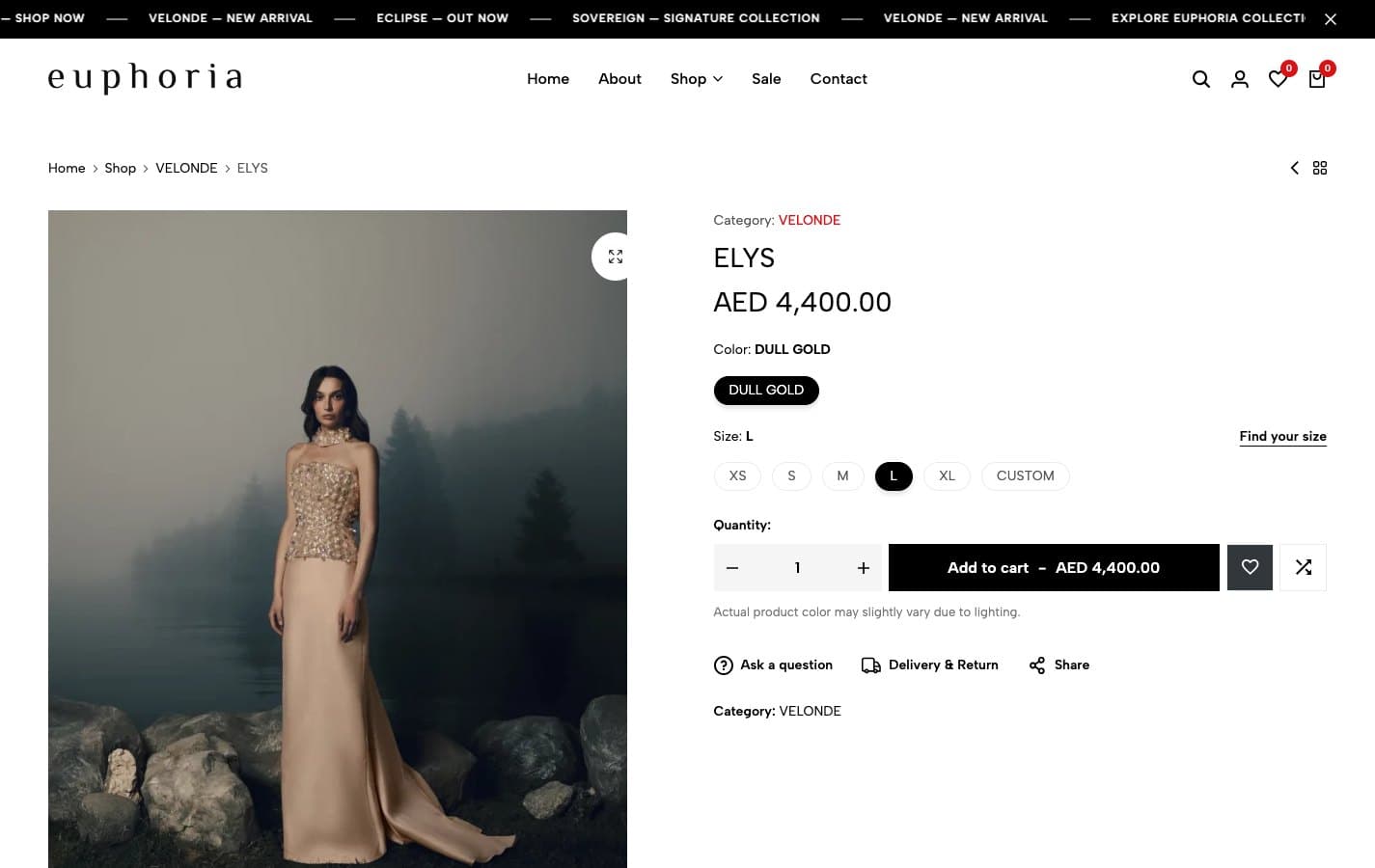
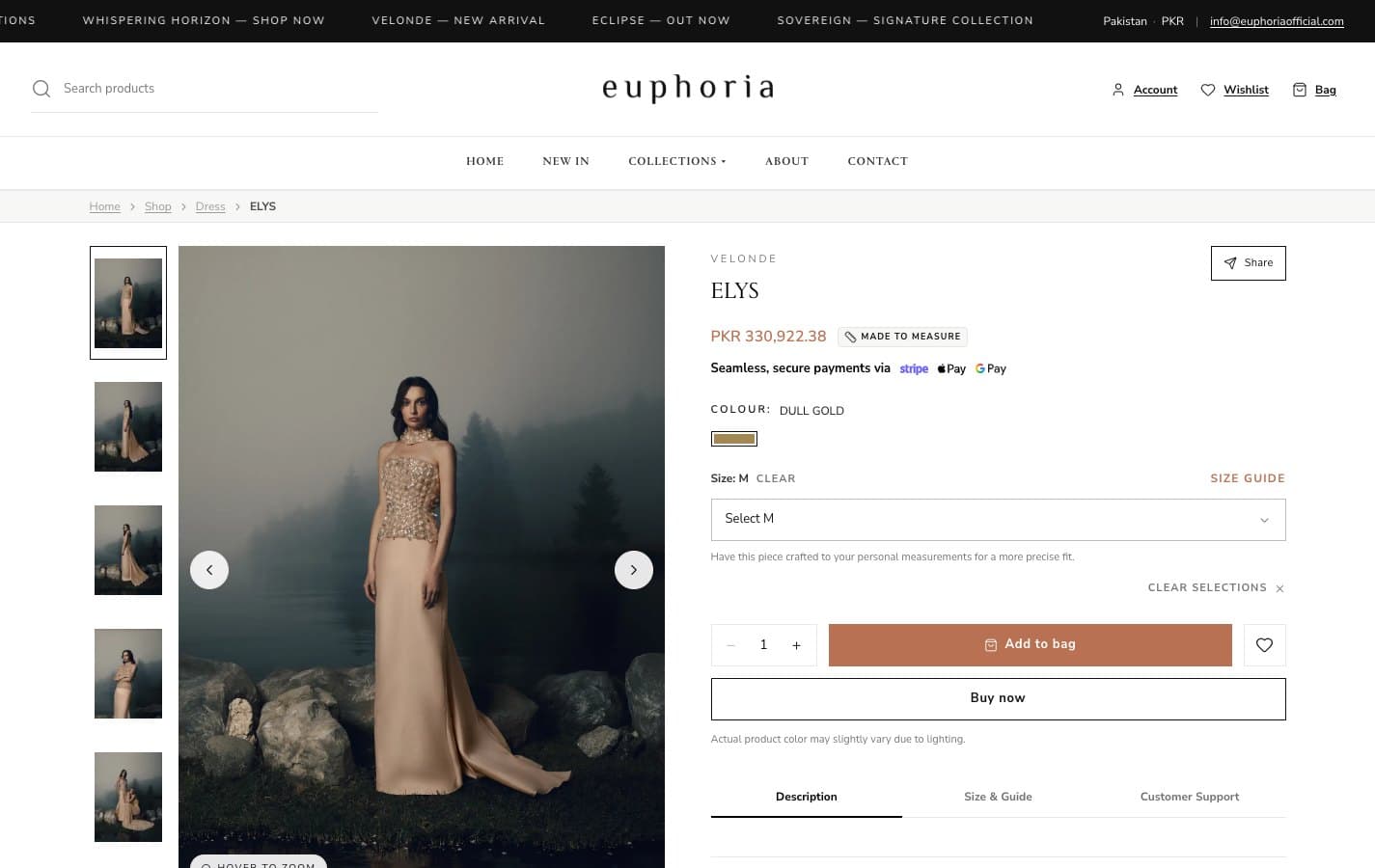
Prices resolve to the visitor's local currency, so the two product screenshots show different currencies. The comparison is about the page, not the price.


Left: the WordPress page on mobile (20.38 s). Right: the rebuilt page (1.33 s). The image is the same file. The difference is everything the browser had to do before it could show it.
The numbers
Lighthouse, cold cache, mobile emulation with simulated 4G for the mobile figures and desktop for the rest. Both sites were live and publicly reachable; neither was tuned for the test.
Mobile — the customer's device
| Metric | Before | After | Change |
|---|---|---|---|
| Home — Largest Contentful Paint | 5.42 s | 1.41 s | −74% |
| Product page — Largest Contentful Paint | 20.38 s | 1.33 s | −93% |
| Home — Time to first byte | 1.65 s | 1.05 s | −36% |
| Product page — Time to first byte | 2.21 s | 0.36 s | −84% |
| Product page — Blocking time | 3,459 ms | 570 ms | −84% |
| Home — Page weight | 1,914 KB | 458 KB | −76% |
| Product page — Page weight | 2,813 KB | 455 KB | −84% |
| Product page — JavaScript | 976 KB | 331 KB | −66% |
| Requests — product page | 144 | 31 | −78% |
| Lighthouse performance score | 29 / 100 | 84 / 100 | +55 pts |
Desktop
| Metric | Before | After | Change |
|---|---|---|---|
| Home — Largest Contentful Paint | 2.03 s | 0.53 s | −74% |
| Product page — Largest Contentful Paint | 5.96 s | 0.55 s | −91% |
| Home — Time to first byte | 0.44 s | 0.36 s | −17% |
| Product page — Time to first byte | 0.61 s | 0.35 s | −42% |
| Product page — Blocking time | 262 ms | 32 ms | −88% |
| Home — Page weight | 2,033 KB | 431 KB | −79% |
| Product page — Page weight | 2,684 KB | 455 KB | −83% |
| Product page — JavaScript | 992 KB | 332 KB | −67% |
| Requests — product page | 168 | 33 | −80% |
| Lighthouse performance score | 52 / 100 | 97 / 100 | +45 pts |
Methodology: Lighthouse 12, Chrome, cold cache, no extensions. Mobile runs use Lighthouse's simulated 4G profile; desktop runs use the desktop preset. Page weight and JavaScript are transferred bytes from the network log. Runs vary by a few percent between executions; the differences above are far larger than that variance.
Speed is the first checkout step. These are the rest.
A product page that arrives in time
1.33 seconds to the main image on mobile, down from 20.38. The dress is on screen before the shopper's patience runs out — on the device most of them are holding.
A mobile store that behaves like the desktop
The same editorial composition, the same product detail, the same checkout — not a stripped-down mobile theme that hides the brand.
A checkout with fewer excuses
Apple Pay, Google Pay, cards, guest checkout and a saved draft. Regional pricing and delivery are resolved at the moment of purchase, not in a support reply.
Merchandising without a developer
Products, collections, delivery rates, tax rules, discounts and tailoring options are all editable by the client's team, with the design protected.
A platform that can carry the next collection
New collections, currencies, delivery markets and made-to-measure rules are configuration, not a rebuild. The storefront is not boxed in by a template.
A store you can measure
Every Core Web Vital in the good band on both key templates. When the next conversion initiative starts, it starts from a floor that can hold it.
What changed for the business
| Before | Now |
|---|---|
| One address for one market | Multi-currency, multi-country pricing from the first visit |
| A product grid | Collections presented as editorial destinations |
| Card payment only | Card, Apple Pay, Google Pay, express checkout |
| Sizing as a paragraph of text | On-page size guide plus a guided made-to-measure flow |
| Guest orders handled by email | Self-service order tracking |
| Catalogue edits routed through a developer | A back office the team runs itself |
| A phone experience that lagged the desktop | A mobile-first build measured on mobile first |
A shopper who cannot see the dress cannot want the dress. Google's guidance is that mobile pages should show their main content within 2.5 seconds; beyond three seconds, more than half of mobile visitors leave. Deloitte's retail study found that a 0.1-second improvement in mobile load time correlated with an 8.4% lift in conversions.
The legacy product page took 20.4 seconds on mobile. That is not a page on the edge of the threshold — it is more than eight times the 2.5-second target. The rebuilt page lands at 1.33 seconds, inside the "good" band for Largest Contentful Paint.
We are not going to multiply 19 seconds by a published percentage and sell you a revenue figure. The relationship between speed and conversion is not linear that far out, and anyone who presents it that way is guessing. What we can state is the mechanism every retailer runs into:
Fewer abandoned first impressions
The hero and the product image arrive before the shopper's patience runs out.
More product pages seen
Each page is a fraction of the weight, so browsing does not cost the customer seconds at a time.
Less friction at the bag
No plugin chain to load, Apple Pay and Google Pay available, no forced sign-up.
A store that survives a bad connection
The gap is widest exactly where fashion traffic lives: a phone, on mobile data.
The commercial proof is the platform we now measure from: every Core Web Vital in the good band on both templates, on the device most customers use. That is the floor a conversion programme can be built on — and a floor the old site could not reach on any hosting tier.
The same standard, applied to your storefront.
We do not sell a template and hope. Whether you need the storefront rebuilt, the traffic to fill it, or one team to run all of it, these are the ways in.
One SubscriptionBest fit
Your entire digital department — web development, design, SEO, marketing and hosting under one monthly fee, delivered through ModSuite.
Explore subscription plans
Web Development
Storefronts and websites built for speed and conversion — the same standard this case study measures, scoped to your catalogue and checkout.
See web development plans
SEO Strategy
Technical foundations, content and authority — so the store you just made faster is also findable for the products people search for.
See SEO plans
Marketing
Paid social, search and campaign management that sends qualified traffic to a storefront that can now convert it.
See marketing plans
Prices shown are current list prices from our service marketplace; live offers and campaign discounts are applied at checkout.
Want your store measured like this?
We audit the live site, not a demo: homepage, product page, bag and checkout on the device your customers actually use. You get the numbers and the list of causes, whether or not you work with us afterwards.